TL;DR:
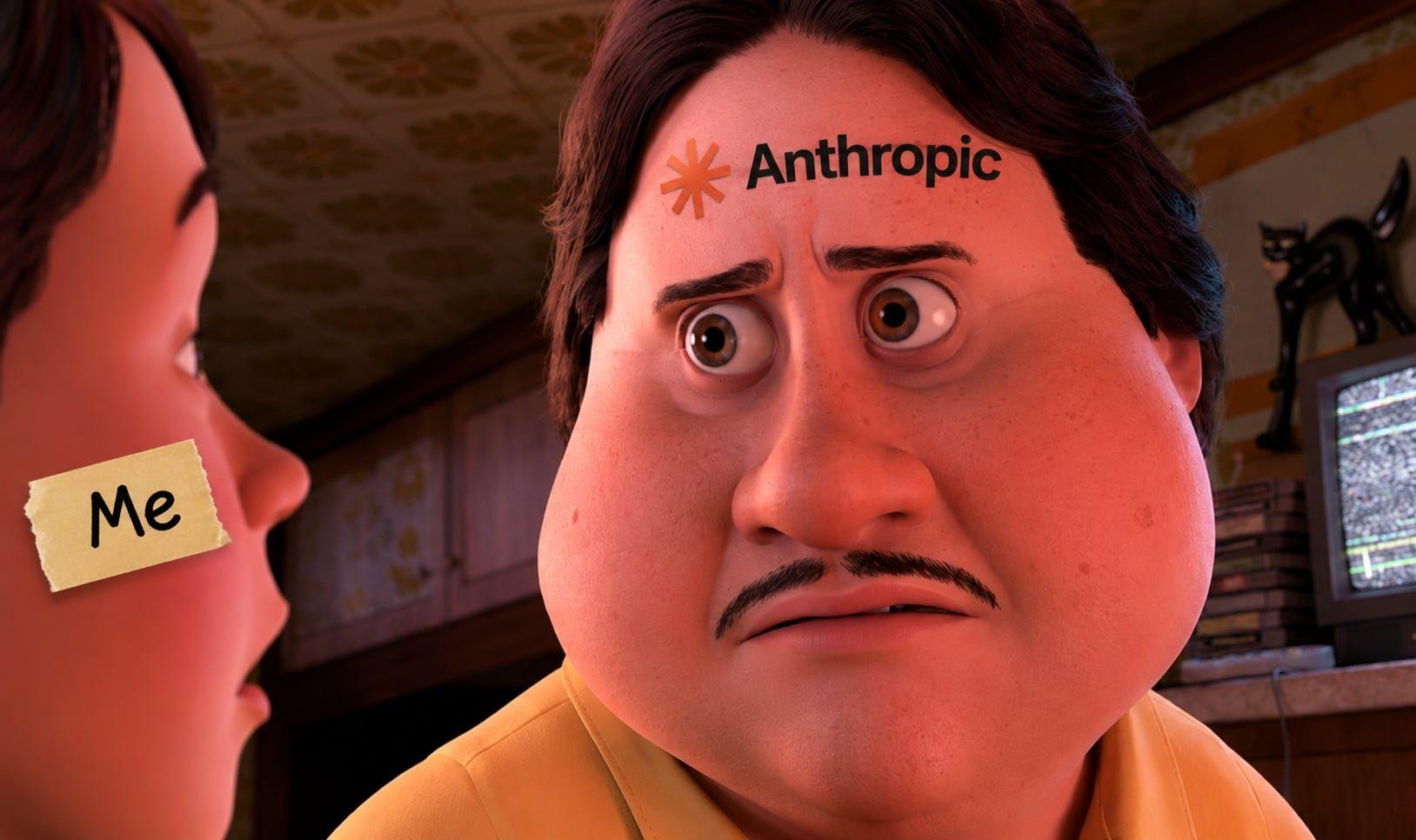
I used to think AI was mostly hype. Now I’m fascinated by it, using it constantly in my work, and even considering AI research. It has made me faster, more curious, and more willing to build things I might have ignored before.
At the same time, I’m becoming more dependent on it, questioning what happens to originality and craft, and I’ve just lost a job in circumstances where AI-assisted automation likely played a part.
So this isn’t really an argument for or against AI. It’s about sitting with the contradiction: AI is expanding what we can do, while also changing what the world may need us to do.
A few years ago, I thought AI was another tech-bro obsession. One of those things Silicon Valley couldn’t stop talking about that would eventually settle down once the hype wore off.
Well, I was wrong.
Fast-forward to 2026, and I’m spending a ridiculous amount of time experimenting with AI tools, watching interviews with researchers, listening to podcasts about frontier models, and trying to understand where all of this is going. I’m even considering pursuing a PhD in some sort of AI research.
And somewhere in the middle of all this excitement, I lost my job.
Not entirely because of AI, at least not explicitly. But AI certainly seems to have played a part. So here I am, fascinated by a technology that’s making me more excited about my work than I’ve been in years, while simultaneously wondering what it means for the future of that work.
I haven’t quite figured out how I feel about it.
AI has made me want to work more
I’ve been a product designer for about four years now. Most of that time has involved the usual design process: understanding problems, researching, exploring ideas, creating wireframes, designing interfaces, testing things, making changes, and eventually handing things over to engineers.
I enjoy designing. I always have. But there’s something about the process of taking an idea from zero to one that has become incredibly exciting lately. And surprisingly, it isn’t necessarily because AI makes me work faster.
It’s because AI makes me want to work more.
Before, I’d have an idea for something I wanted to build, and immediately I’d start thinking about everything required to bring it to life. The designs, the development, the time, the technical knowledge I might not have. Sometimes, just thinking about the amount of work involved was enough to make me put the idea aside.
These days, that barrier feels considerably smaller.
I can have an idea in the morning and have something functional to interact with by the afternoon. Something that previously might have required an engineer, or weeks of learning and experimenting. And that’s genuinely exciting.
I’ve found myself more willing to take on projects, help friends build things, and experiment with ideas simply because I know I can get somewhere with them. For someone who enjoys creating things, that’s an incredible feeling.
I still care about the craft. I just approach it differently.
I’ve noticed is how much my design process has changed.
I still spend a lot of time looking at existing products, exploring interfaces, collecting references, and studying how other people have approached similar problems. I’ve always done that.
I think developing good taste is an important part of being a designer. Being able to recognise what works, what doesn’t, and why something feels right is a skill in itself.
But I don’t necessarily spend as much time manually exploring every idea in Figma anymore. Sometimes I’ll sketch something quickly or create a rough layout to communicate what I want. Other times, I’ll connect an existing Figma file to an AI coding tool through MCP and start building directly.
And then I iterate. A lot. Over and Over again.
Because contrary to what some people might think, AI doesn’t magically produce exactly what you want every time. Sometimes the output is awful. Sometimes it’s almost right. Sometimes it completely misunderstands what should have been a fairly straightforward instruction.
And sometimes, to my surprise, it comes up with something I hadn’t considered. That’s the part I find particularly interesting.
I’ve had situations where I’ve designed an entire flow in Figma, connected it to an AI tool, and realised during implementation that I’d overlooked something. Rather than returning to Figma to redesign that small interaction, I might let the AI suggest a solution.
Sometimes its suggestion is genuinely good. Other times, I have to correct it repeatedly until we arrive at something I’m happy with.
The point is that I’m still making decisions. I’m still evaluating the output. I’m still bringing my understanding of design, users, and products into the process. I’m just not manually executing every single thing anymore.
And I quite like that.
But am I becoming lazy?
This is where things get a little uncomfortable.
Because as much as I enjoy this new way of working, I’ve noticed something about myself. I’m becoming less willing to do certain things manually.
Something as simple as changing the colour of an SVG, for example. I know how to do that. I’ve done it countless times. I could open Figma, make the change, and export the file.
But if I’m already working with an AI tool, I’ll probably just ask it to do it.
Why interrupt my workflow to open another application when I can get the same result without leaving where I am? It sounds reasonable. And for relatively small projects, perhaps it is.
But it makes me wonder.
At what point does convenience become dependency?
There’s a difference between knowing how to do something and choosing to automate it, and gradually losing the ability or patience to do it yourself. I don’t think I’m at that point yet.
For more complex or high-stakes projects, I still want to work through the design properly. I want control over the details, the interactions, the decisions, and how everything comes together.
But I can’t pretend my habits haven’t changed. And perhaps that’s what concerns me more than the technology itself.
If AI can do something faster than I can, how much effort should I put into remaining good at it?
I don’t have a particularly good answer to that question yet.
Superintelligence for twenty bucks?
There’s something almost absurd about the moment we’re living in.
For twenty bucks a month, you can access AI systems capable of writing code, analysing information, generating images, explaining complex subjects, and helping you build things that would have been significantly more difficult just a couple years ago.
To be clear, I’m not suggesting we’ve achieved superintelligence, because I’m not sure we humans even know what that truly means yet.
But the capabilities already available to people are remarkable. And the more I’ve learned about AI, the more interested I’ve become in what happens behind the scenes.
Over the past few years or so, I’ve gone from casually experimenting with frontier models to listening to researchers discuss responsible scaling laws, mechanistic interpretability, AI safety frameworks, and how models handle context and memory.
Particularly, context and memory management, which raises interesting questions about how AI systems retain, retrieve, and use information over time. These are areas I’m now considering pursuing research opportunities in.
Which is funny, considering I initially thought the whole thing was a bubble.
Maybe it is, Idk. But whether the bubble bursts, or the technology is paced, AI is already changing the scope of work across a lot of disciplines.
I think my role became redundant
I recently lost my job as a product designer.
I’d spent around three to four years at the company, working on its products and helping shape their experiences. I was also the only designer.
Now, I could easily turn this into a story about how companies are replacing talented people with AI without understanding the value of their work. And perhaps there’s some truth to that in certain situations.
But I don’t think that would be an entirely fair representation of mine.
Most of the company’s products had already been designed. A lot of the foundational work was done. Of course, products are never truly finished. There are always improvements to make, new problems to solve, and opportunities to create better experiences.
But the volume of substantial design work wasn’t necessarily what it had been previously.
I guess higher leadership wanted to automate more of its processes, and there was a belief that other team members could handle some of the remaining design responsibilities, presumably with the help of AI.
From a business perspective, I can understand the reasoning.
If the amount of work requiring a dedicated designer has reduced, and existing team members have tools that make them more capable, keeping someone employed full-time becomes a harder decision to justify.
I don’t particularly enjoy being on the receiving end of that calculation. But I understand it.
What I find more interesting is what this means for how companies value good design.
Because producing an interface and designing a good experience aren’t necessarily the same thing. AI can generate an attractive dashboard in minutes.
But does that dashboard solve the right problem? Does it reflect how people actually behave? Have we understood the user’s needs, the business constraints, and the trade-offs involved?
And I think there’s a risk that organisations begin to confuse the ability to generate something with the ability to make informed decisions about what should be generated in the first place.
That said, I also recognise that AI is becoming increasingly capable of supporting those decisions. Which brings me back to the same uncomfortable position.
I can see both sides.
Maybe we’re just going to need fewer people
Here’s another thought I’ve been struggling with.
If AI genuinely allows one person to accomplish work that previously required several people, is it unreasonable for companies to employ fewer people?
Businesses have always adopted technologies that improve efficiency. And it’s difficult to argue against that principle when I’m personally benefiting from the same improvements.
I’m a designer who can now build functional products with considerably less engineering assistance than I previously needed.
I celebrate that.
But when a company decides it can operate without a dedicated designer because its engineers now have access to similar tools, I suddenly find myself on the other side of the equation.
It’s a strange feeling.
I benefit from AI making certain skills more accessible to me, while worrying about what happens when my own skills become more accessible to everyone else.
And perhaps that’s one of the more difficult conversations we need to have about AI. Not simply whether it will replace jobs, but how we think about expertise when the ability to execute tasks becomes increasingly widespread.
I still believe domain knowledge matters enormously.
Someone who understands product design, user behaviour, and interaction principles is likely to approach an AI-assisted design task differently from someone who doesn’t. The same applies to engineering, research, and countless other disciplines.
But I also don’t want to assume that this will always be enough to protect existing roles.
The technology is improving, and the boundaries of what it can do are changing. It’s possible to recognise the importance of human expertise without pretending that every existing job will remain necessary.
Ultimately, I believe being able to understand what people need and when and also able to sell ideas is the skill that will stand the test of time
Slop fest
There’s another concern I haven’t quite worked through.
If we’re increasingly using the same models to generate our designs, our writing, our code, and our ideas, what happens to originality?
I already see a certain sameness in some AI-generated products. Similar layouts. Similar interactions. Similar visual decisions create what is now known as “AI Slop”
Things that look polished at first glance but don’t necessarily have much thought behind them.
I really dislike that.
But then I think about how creativity has always worked. Very few ideas exist in complete isolation.
We observe things, borrow concepts, combine influences, and build on what others have done. Even before AI, much of my design process involved studying existing products and understanding what made them successful.
Perhaps originality has always been about connecting existing ideas in ways that produce something new.
And perhaps AI is simply making those connections faster.
Still, I wonder whether there’s a difference between using existing ideas as inspiration and allowing a model to make most of our creative decisions.
I don’t think the answer is to reject AI-generated work. But I do think we need to remain intentional about what we create.
Having access to a tool that can produce almost anything doesn’t necessarily mean we should accept everything it produces.
Taste, judgement, curiosity, and the willingness to question an output still matter.
At least, I hope they do.
So, where does that leave me?
I’ve spent the last four years building a career in product design, and I’m more excited about creating things today than I have been in a long time.
AI has opened up possibilities I previously considered difficult or inaccessible.
I can design something, turn it into code, experiment with ideas, and build functional products without necessarily waiting for someone else to bring them to life.
That’s incredible.
I’m also becoming increasingly interested in the technology itself, to the point where I’m considering moving into AI research.
But at the same time, I’ve recently lost a job in circumstances where AI-assisted automation appears to have been part of the thinking.
I’m concerned about what happens to creative skills when we stop practising them. And I’m concerned about what the future of work looks like when increasingly capable tools allow companies to accomplish more with fewer people.
Yet none of those concerns has made me want to stop using AI.
Quite the opposite.
I want to understand it better. I want to experiment more. I want to build more things.
Maybe that’s the contradiction I’ve been trying to make sense of.
I’m excited about a technology that’s expanding what I can do, even as it changes what the world might need me to do.
And for now, I think it’s okay to be excited and worried at the same time.
I certainly am.